
Most people treat YouTube as a streaming platform, but experienced users know it doubles as the world’s largest audio library. The real question isn’t whether to convert — it’s which format serves your workflow best.
Thank you for reading this post, don't forget to subscribe!The MP3 versus WAV debate gets ignored by casual users who just grab whatever output lands first. Seasoned practitioners, however, evaluate bitrate, compression trade-offs, and format-options before committing to any single download decision.
Offline access changes how people consume content entirely. When internet connection drops mid-commute, your pre-converted audio library keeps podcasts and songs playing. That reliability alone justifies building a proper offline collection through a trusted converter tool.
Copy, paste, URL — these three actions sit between you and any video you want as audio. The browser-based flow eliminates bloat, viruses, and unnecessary register steps. No login, no personal information surrendered — just clean, fast processing from link to device.
320kbps versus 128kbps versus 256kbps — the quality gap is audible on decent speakers. Free tools that support 192kbps and higher give users real format control. The result on screen after a clean query should always be a safe, ad-free, simple saving experience.
What Is a YouTube to MP3 Converter and How Does It Work?
The term converter gets thrown around loosely, but understanding what actually happens during processing separates informed users from frustrated ones. A YouTube to MP3 tool doesn’t copy — it extracts, re-encodes, and delivers audio in a new container format.
YTMP3 became famous not through advertising but through word-of-mouth from novice users who discovered a genuinely convenient service. The user-friendly interface removed every technical barrier that previously made audio extraction feel inaccessible to non-technical people.
What makes the best converters different is how they operate without exposing users to third-party apps or unnecessary software installations. The entire functionality runs in-browser, which means your device stays clean and the process stays within one browser tab.
Easy steps, intuitive design, and fast results — these aren’t marketing claims, they’re the baseline expectation now. Any converter requiring more than a copy–paste of a pertinent link has already failed the modern user before the first convert even begins.
The most underrated aspect of YTMP3 is what it doesn’t do — it doesn’t require accounts, doesn’t demand registration, and stays accessible on any internet-enabled device. The rest of the market still hasn’t matched that free, no-friction, directly available service model.
How to Convert / Download YouTube Videos as MP3
From CnvMP3:
Most tutorials start at step one. Let’s start at the failure point instead — a broken URL in the browser address bar is why most convert attempts fail before they begin. Always verify the link structure matches standard YouTube watch format first.
The share button on YouTube generates a cleaner URL than copying directly from the address bar in some browser environments. Practitioners who download regularly know this distinction saves troubleshooting time. Copy from share, not always from the bar itself — small habit, big difference.
YouTube Shorts introduced a separate URL structure that confused early converter users. Today, the default MP3 format setting handles Shorts seamlessly. Paste the Shorts link the same way — the converter identifies the source type and adjusts processing automatically behind the scenes.
The CONVERT button is the least interesting part of the process, yet it’s where most users stare anxiously. What matters more is the format selection made before that click. MP3 versus MP4 — the decision upstream of the button determines everything about your output.
Destination path selection is chronically underplanned. Most users save files to default device folders and lose them immediately. Experienced practitioners create dedicated download folders by content type — music, lectures, podcasts — making every MP3 or MP4 search instant and every saving decision intentional.
From YTMP3:
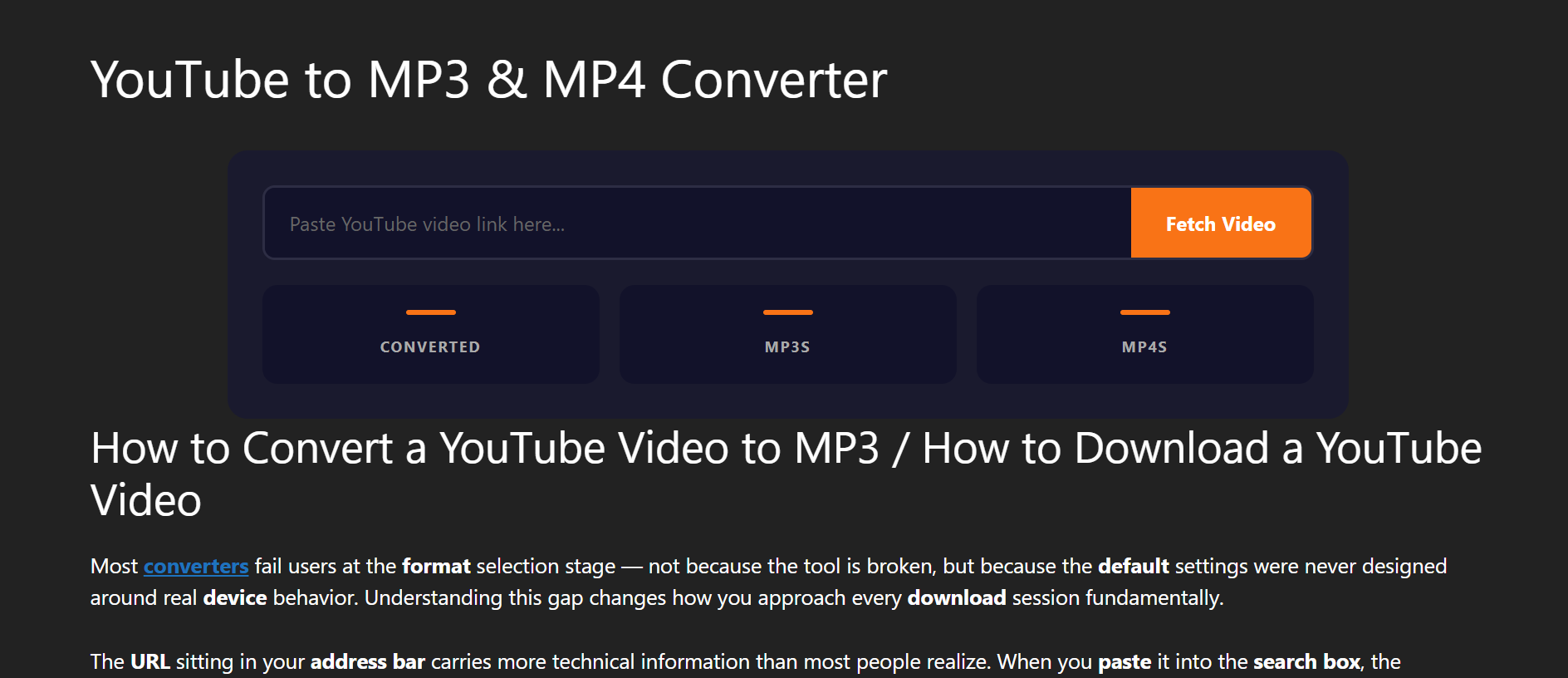
The main page of YTMP3 is deliberately sparse — and that’s intentional product philosophy, not laziness. Every element removed is a distraction eliminated. The centered text box signals exactly where your YouTube link belongs without requiring a tutorial to understand.
Opening a new browser tab before pasting protects your original YouTube video session. Experienced YTMP3 users keep the source video open in one tab and the converter in another — a simple workflow habit that makes re-downloading or format switching dramatically faster and less frustrating.
Address bar versus share link — the YTMP3 system accepts both, but the bar URL sometimes carries tracking parameters. These don’t break processing, but clean links from the share option tend to resolve faster. This is a minor but observable step in high-volume usage scenarios.
Select MP3 or MP4 before hitting convert — not after. The page resets format preference on some browser sessions after conversion completes. Building the habit of confirming format audio selection on every new tab open prevents a surprising MP4 arriving when you wanted an MP3 file.
The download link appearing on page after processing completes is the most satisfying moment in the workflow. But don’t close the tab immediately — verify the file landed on your device correctly before ending the session. The box clears and the link expires faster than expected.
How to Use the Converter in Three Steps
The three-step framework is psychologically effective because it makes converter usage feel manageable. But practitioners know the real skill lives in step one — building an accurate search query that surfaces the exact video without scrolling through irrelevant result pages on screen.
Title searches outperform direct URL paste in one specific scenario — when you’re unsure of the exact video version you want. Typing a partial title into the converter panel lets you compare result options visually before committing to any single download decision.
Format selection between MP3 and WAV deserves more deliberation than users give it. MP3 produces smaller audio files optimized for playback. WAV delivers uncompressed output suited for editing. Choosing without understanding the difference wastes both storage and post-processing time on your device.
The browser-based converter finishes faster than most users anticipate on the third step. The common mistake is clicking away before the download completes. Stay on screen until the file confirms delivery to your device — especially on mobile browser sessions where background processing gets interrupted.
Finish the session by verifying file integrity, not just file presence. A corrupted MP3 or truncated WAV output looks identical to a healthy download in most file managers. Quick audio playback check — even ten seconds — confirms the link-to-device convert cycle completed without errors.
Why Use a YouTube to MP3 Converter?
The offline case for YouTube to MP3 conversion gets made constantly — but the storage argument rarely gets examined honestly. A three-hour lecture saved as MP3 occupies a fraction of the disk space its video equivalent demands, freeing device capacity for what actually matters.
Podcast lovers discovered YouTube audio years before dedicated platforms caught up. Converting favorite creator content into MP3 files meant building personal libraries that no algorithm, paywall, or platform shutdown could erase. The offline independence this creates is worth more than any streaming subscription.
Ad-free consumption isn’t just comfort — it’s a productivity decision. Internet connection quality affects streaming audio constantly, introducing buffering and interruptions. A pre-downloaded MP3 plays clean regardless of network conditions, making it the professional’s choice for music and podcast focus sessions.
The safest converter tools distinguish themselves not through features but through what they don’t do — they don’t collect user information, don’t register your behavior, and don’t inject viruses or bloat into your device. Safe means no data trail, not just no malware. That distinction matters significantly.
High-quality audio at 180 minutes supported length sounds like a technical spec until you’re converting a 3–hour conference recording. Fast, efficient, time-saving tools that handle MP4 alongside MP3 eliminate the need for separate software. One converter handling all settings and formats is simply best practice.
Why Select / Choose a YouTube to MP3 Converter?
The multitude of converter options online creates a paradox of choice that sends most users back to the first result they find. YTMP3 survives that competition not through marketing but through genuine simplicity that experienced users immediately recognize and return to repeatedly.
Technologically challenged users represent the majority of YouTube audio consumers — not developers, not audiophiles. A converter that forces technical decisions upfront loses that audience immediately. The best tools understand that navigate effortlessly means removing every decision that doesn’t directly serve the download goal.
Conversion speeds separate theoretical tools from practical ones. A web-based system with slow processing defeats the entire purpose of a fast, no-software workflow. Users who’ve tested multiple platforms consistently report that YTMP3 processes requests at speeds that validate the no-bloatware device experience.
The signup and account requirement debate is settled by user behavior data — platforms demanding registration see dramatically lower conversion completion rates. YTMP3 understood early that eliminating hassle at the entry point converts more casual visitors into regular internet tool users permanently.
Completely free with no strings attached sounds like marketing language until you compare it against apps that start free and gradually introduce paywalls. The ultimate converter maintains zero-cost access indefinitely — a business model sustained by user volume rather than individual user subscription instantly extracted.
Choose the Format That Fits What You Need
The MP3 versus WAV decision gets framed as quality versus size, but that framing misses the actual variable — intended use. Everyday listening on earbuds doesn’t reveal what uncompressed WAV audio preserves. The format choice should follow the playback environment, not just personal preference.
Smaller files aren’t inferior files — they’re optimized files. MP3 compression removes frequencies human ears struggle to perceive during casual listening. The practical result is a format that performs identically to WAV in most real-world output scenarios while consuming dramatically less storage space.
Professional audio editing reveals the actual ceiling of MP3 limitations. When applying EQ, compression, or layering in post-production, WAV‘s uncompressed data structure prevents the artifacts that degraded MP3 introduces. Switch to WAV the moment your workflow moves beyond passive listening into active editing territory.
The larger WAV output creates a secondary challenge — transfer speed. Moving uncompressed audio files between devices or into editing software takes measurably longer than MP3. Practitioners who work across multiple devices daily factor transfer time into their format decision, not just final storage impact.
Format flexibility is the underrated feature of modern converters. The ability to switch between MP3 for everyday consumption and WAV for production work within the same tool eliminates the need for separate workflows. Choose based on destination, not habit — both formats serve distinct, legitimate purposes.
Which MP3 Quality Should You Choose? — Bitrate Guide
Bitrate is a data density measurement, not a quality guarantee. 128kbps delivers adequate audio for speech content — podcasts, lectures, interviews. The file size efficiency at this level makes it the rational default for content where sonic richness isn’t the primary concern.
The balanced middle range of 192kbps and 256kbps is where most music listeners actually belong, despite defaulting to 128kbps out of habit. Faster downloads at lower bitrate feel like a win until you play the file on quality speakers and notice what’s missing from the audio.
320kbps represents the practical ceiling for MP3 — beyond this, the format’s compression architecture can’t preserve additional data. Audiophiles who demand truly uncompressed audio should migrate to WAV entirely. 320kbps is the highest MP3 quality available, not the highest audio quality achievable.
Smaller files at 128kbps versus richer audio at 320kbps — the decision should factor in your storage capacity, playback hardware, and content type simultaneously. A guide that prescribes one universal bitrate ignores these variables. Match the option to the specific listening scenario, not to a blanket recommendation.
High-bitrate MP3 and WAV serve overlapping but distinct audiences. The practitioner’s approach is maintaining both — 128kbps downloads for mobile consumption, 320kbps or WAV for desktop listening sessions. This dual-format strategy maximizes both storage efficiency and audio fidelity across different file usage contexts.
How to Use CnvMP3 to Download TikTok Video
TikTok video architecture differs from YouTube in ways that affect converter behavior. The URL structure changes depending on whether you’re accessing via app or browser — a detail that catches new users off guard when their first paste into the input field fails unexpectedly.
The copy mechanism on TikTok is buried inside the share menu, not the browser address bar. Experienced downloader users navigate directly to the share option rather than attempting to manually grab the URL — this produces a clean link that the converter processes without errors.
MP4 is the only rational format choice for TikTok video download — audio-only MP3 strips the visual context that defines the platform’s content. The input field accepts the TikTok URL regardless of video length, and the convert button initiates processing identically to any other supported source.
What makes this converter the safest option for TikTok downloads isn’t just security — it’s the absence of redirect chains. Other internet downloader tools route TikTok URLs through multiple servers. This free converter processes the MP4 button request directly, reducing exposure to third-party data interception significantly.
TikTok‘s algorithm surfaces content you won’t find again easily — making download decisions time-sensitive. Having a reliable converter with a clean input field and one-button MP4 delivery keeps your reaction window short. Free, internet-based, and consistently safest — this workflow becomes second nature quickly.
How to Use CnvMP3 to Download Reddit Video
Reddit hosts video content across thousands of subreddits, but its native player actively discourages saving. The URL structure for Reddit video requires the full post link — not the direct media URL — for any converter input field to process it successfully without errors.
The copy action on Reddit isn’t standardized across platforms. Mobile app Reddit generates share URLs that include tracking parameters, while browser Reddit produces cleaner direct post links. Practitioners consistently paste the desktop browser version into the converter input field for more reliable MP4 download results.
Reddit video and audio are stored separately on the platform’s servers — a technical reality that cheaper converter tools handle poorly. The safest internet downloader options merge both streams automatically during convert processing, delivering a complete MP4 file rather than a silent video that confuses users.
Free downloader access doesn’t mean equal downloader quality. The convert button on lower-quality tools triggers Reddit URL failures because they haven’t updated their internet parsing logic. Reliable converters maintain active Reddit input compatibility — a maintenance commitment that distinguishes professional tools from abandoned projects.
Saving Reddit video content serves archival purposes that the platform itself doesn’t support. Communities get banned, posts get deleted, and video evidence disappears. A consistent MP4 download workflow using a trusted, free, safest-rated internet converter builds a personal archive that survives platform moderation decisions permanently.
How to Use CnvMP3 to Download Instagram Reel
Instagram Reel URLs behave differently depending on whether you’re accessing the platform through the app or a browser. App-generated share links often redirect through Instagram‘s tracking layer — a detail that affects how reliably any converter input field resolves the Reel download request.
The copy action within Instagram‘s share menu generates the most converter-compatible URL format. Practitioners skip the browser address bar entirely for Instagram Reels — the share-generated link resolves faster in the input field and produces cleaner MP4 output with fewer processing interruptions along the way.
Reel content disappears from public view when accounts go private or get deactivated. The download window for preserving valuable Instagram Reels is shorter than users assume. A reliable internet converter with a fast input-to-convert button workflow makes that preservation decision actionable within seconds of discovering the content.
MP4 format is non-negotiable for Instagram Reel downloads — the vertical video format and embedded audio exist as one file on the platform. Splitting into MP3 loses the complete Reel experience. The convert button on a safest-rated free converter preserves both elements intact automatically.
The underappreciated advantage of internet-based Instagram downloader tools is cross-device accessibility. The same free converter that processes a Reel URL paste on desktop works identically on mobile — no app installation, no account sync required, just consistent MP4 download delivery across every device you own.
How to Use CnvMP3 to Download Facebook Video
Facebook video content spans formats that other platforms don’t — live replays, Watch originals, group-exclusive posts. Each carries a distinct URL structure that less sophisticated converter tools mishandle. The input field of a properly maintained downloader accepts all Facebook video link variants without user-side troubleshooting.
The copy URL option on Facebook isn’t always obvious. For public posts, right-clicking the video timestamp reveals the direct link. For mobile users, the share menu exposes the URL more directly. Either copy method works when pasted into a capable converter input field — format compatibility is the real variable.
Facebook restricts video download natively because it serves platform retention goals, not user ownership goals. This is the practical argument for external internet converter tools — the MP4 file you download from a free, safest-rated downloader is yours permanently, regardless of what Facebook does with its platform later.
The convert button behavior for Facebook video differs slightly from YouTube processing — resolution options may be limited depending on the source video quality. Experienced downloader users accept the available MP4 output rather than chasing unavailable quality levels that the source video simply doesn’t contain.
Facebook video archival through a trusted internet downloader is increasingly common among researchers, journalists, and content creators who need free, permanent access to social documentation. The safest converter tools handle these URL types without storing user data — making the MP4 download both legally defensible and privacy-preserving.
How to Use CnvMP3 to Download Twitch Clip
Twitch clip culture creates a documentation problem — highlight moments get shared heavily for 48 hours then vanish from mainstream visibility. The URL for any Twitch clip is accessible from the clip page itself, and copying it directly into a converter input field initiates the download process immediately.
The Twitch platform generates permanent clip URLs that don’t expire — unlike stream VODs which Twitch deletes after 14-60 days. This means Twitch clip download via internet converter is less urgent than VOD preservation, but the safest workflow remains the same — paste, select MP4, convert button.
MP4 format captures the gaming moment, reaction, or highlight in its full visual context. Converting a Twitch clip to audio-only MP3 strips the visual element that makes the clip worth saving. The convert button on any reputable free internet downloader defaults correctly to MP4 for Twitch clip sources.
What separates safest-rated Twitch downloader tools from average ones is clip resolution handling. Twitch clips are encoded at the broadcaster’s stream quality — 1080p, 720p, or lower. A reliable free internet converter delivers the MP4 at source resolution without artificially downgrading the clip file during processing.
Community archivists who document Twitch clip history across gaming events, charity streams, and cultural moments rely on consistent downloader access. The free, internet-based converter with a clean URL input field and single convert button workflow supports that archival mission without technical barriers or hidden costs.
How to Use CnvMP3 to Download Twitter Video
Twitter video has a compression problem that users rarely discuss — the platform re-encodes uploaded video aggressively, degrading quality from the original. When you download a Twitter video via internet converter, you’re retrieving the platform’s compressed version, not the creator’s original MP4 file — a critical distinction.
The copy URL process on Twitter requires accessing the tweet’s individual page, not the timeline view. Timeline URL strings often include session parameters that confuse converter input field parsing. The cleanest link comes from opening the tweet directly and copying the address from the dedicated tweet page browser bar.
Twitter‘s video autoplay means users frequently encounter content without consciously seeking it. The download decision is often reactive — you see something worth keeping and need a fast internet downloader ready. Practitioners keep a free, safest-rated converter bookmarked precisely for these spontaneous MP4 preservation moments.
Select MP4 before hitting the convert button — Twitter video is inherently visual content where audio-only MP3 extraction serves narrow use cases. The input field processes Twitter URLs the same as other platforms, but the format selection step matters more here given how much of Twitter video relies on visual context.
The safest internet converter for Twitter video processes requests without storing the URL or logging download activity. Free tools that monetize through data collection contradict the privacy-forward value proposition. Verify that your chosen downloader operates with a clean data policy before making it your permanent Twitter video workflow.
The Legal Side of Converting YouTube to MP3
The legal framework around YouTube to MP3 converting is more nuanced than the binary “copyright bad, free content fine” narrative that dominates online discussions. The actual determination hinges on specific copyright status, territorial laws, and the nature of the downloading activity itself.
Copyrighted material without explicit approval from rights holders violates YouTube‘s conditions of service — this is contractual, not always criminal. The breach occurs at the platform agreement level first. Understanding this distinction changes how you evaluate the risk perspective of different converting behaviors practically.
Content you personally created and uploaded to YouTube is fully available for download — the legal question doesn’t apply. Similarly, Creative Commons-licensed content carries explicit approval for reuse within its own stated conditions. These categories represent genuinely free, legally uncomplicated YouTube to MP3 use cases.
Copyright laws across jurisdictions treat personal archival copying differently. Some territories permit single-copy downloading of content you’ve licensed for personal use — making the same action legal in one country and a violation in another. This jurisdictional complexity is the part most online legal guides oversimplify significantly.
The most useful and defensible posture is conservative — download only content where approval is explicit, available through licensing, or entirely your own. The service you use for converting operates in a gray area regarding platform conditions, but your personal downloading behavior determines your actual legal exposure and risk.
The straightforward reality of YouTube to MP3 conversion is that the technology has matured past the point of difficulty. What separates good practitioners from careless ones is intentionality — knowing which audio format serves which purpose and building a dedicated offline library responsibly.
YTMP3 and similar tools have made audio extraction from YouTube videos genuinely accessible — the interface friction that once discouraged casual users is effectively gone. The remaining barrier is knowledge, not technology. Understanding conversion rates, format trade-offs, and copyright laws is where competency now lives.
Offline content consumption is growing, not shrinking. The internet dependency that streaming created is being deliberately reversed by users who want music and podcasts available regardless of connectivity. Cost-free converter tools enable that independence at zero financial barrier — the only cost is informed decision-making.
Legally using a converter requires knowing what you’re accessing before you download it. Copyright laws aren’t obstacles — they’re the framework that determines whether your offline audio library represents legitimate use or unauthorized extraction. That distinction is worth understanding before building any significant YouTube audio collection.
The practitioners who get the most value from YouTube to MP3 workflows are those who treat accessibility as a responsibility, not just a convenience. Relish your music, curate your podcasts, preserve your audio thoughtfully — and maintain a hassle-free, tailored system that serves both your needs and the creators whose work you’re consuming.
FAQ: What Are the Steps to Take in Order for YTMP3 to Change YouTube Videos Into MP3 Format?
The official YTMP3 website isn’t complicated — it’s deliberately minimal. Most steps confusion comes from users expecting a complex process when the actual convert workflow is three core actions: locate, paste, retrieve. The tool strips away everything that doesn’t serve that fundamental converting sequence.
Desktop access to YTMP3 produces a more reliable experience than mobile for first-time users. The main page layout on desktop exposes all option controls clearly — format select, quality choice, convert trigger — without the compressed mobile view that can obscure secondary settings from new users navigating the page.
The YouTube MP3 file option on YTMP3 appears pre-selected on the main page for a reason — it’s what the majority of users need. The account-free application design means there’s no personalization layer remembering previous preferences. Confirming MP3 is selected before every convert is good operational habit, not paranoia.
Navigate to the file after save — don’t assume it landed in your default download folder without checking. Operating system desktop environments handle YTMP3 download destinations differently across browser configurations. Verifying the MP3 landed in the correct location is the final step in a complete, properly done process.
The convert button triggers a server-side process that typically completes faster than users expect. The psychological tendency to click again assuming the first click failed causes duplicate requests. Trust the tool — one Convert button press initiates everything. The page updates automatically when your YouTube MP3 file is ready to save.
FAQ: Can the YTMP3 App Be Accessed for Free?
The free model behind YTMP3 is a deliberate positioning decision, not a temporary promotional state. The app operates on a volume-sustains-infrastructure philosophy — enough users accessing a zero-cost tool generates sufficient server justification without requiring individual charges or subscription expenses from the user base.
Zero charges creates a psychological accessibility that paid tools fundamentally can’t replicate. A user who hesitates before a free app due to previous bad experiences is a different decision-making moment than one facing a paywall. YTMP3‘s zero-barrier entry converts skeptical first-time visitors into regular returning users effectively.
The expenses question behind maintaining a free converter app is legitimate — servers, bandwidth, and development aren’t costless. YTMP3 has navigated this through community support and donation models rather than advertising or data monetization. That funding approach directly determines why it remains genuinely free to access without compromise.
Users who’ve accessed premium converter tools report that the quality difference rarely justifies the charges. YTMP3‘s free app delivers identical output quality to paid alternatives in most practical usage scenarios. The zero-cost model doesn’t represent a quality compromise — it represents a different business philosophy with the same technical result.
Wiped of paywalls, subscription gates, and per-download charges, YTMP3 operates as a genuinely public utility for audio conversion. The app being free and consistently accessed by millions validates the model. Zero hidden expenses, zero account requirements — just clean, free, unrestricted converter functionality every time you need it.
FAQ: Is an Additional Application Required to Fully Enjoy YTMP3?
The web browser is the only runtime environment YTMP3 needs — and that’s an architectural decision with real implications. Building as a pure online system means zero compatibility programs to maintain across operating systems. The browser handles cross-platform execution automatically, eliminating an entire category of support required overhead.
Additional application installation has a psychological friction cost that most online tools underestimate. Every install request filters out a percentage of potential users. YTMP3‘s browser-native design removes that barrier entirely — the system becomes immediately usable the moment someone lands on the page, with no required intermediate steps.
The online system model does introduce a dependency — internet connectivity is required for the application to function. Unlike installed programs, YTMP3 can’t operate offline during the conversion process itself. This is the honest trade-off of the web-based approach that practitioners should factor into their workflow planning realistically.
Browser compatibility across Chrome, Firefox, Safari, and Edge means YTMP3 reaches more users without additional platform-specific development. The web system updates centrally — when the service improves, every user benefits immediately without downloading patches or managing version programs. This maintenance advantage scales in ways no installed application can match.
The absence of additional required programs isn’t just convenience — it’s a security posture. Every application installed on a device is a potential attack surface. YTMP3‘s online-only system means your device gains zero new software exposure. The web browser you already trust handles everything — no new programs, no new risks.
FAQ: Is Phone Access to YTMP3 Possible?
Phone access to YTMP3 works because the service is built on responsive web standards, not device-specific architecture. The same converter that runs on computers with full peripherals renders correctly on a phone screen — the possible cross-device functionality is a byproduct of good foundational web development.
The devices that benefit most from mobile YTMP3 access are tablets — the screen real estate matches the converter’s layout better than phones while maintaining full portability. Practitioners who convert regularly often report that tablet sessions produce fewer accidental mis-taps than phone sessions during format selection and convert initiation.
Restricted functionality is the concern users raise about mobile access — and it’s largely unfounded for YTMP3. The service delivers identical conversion capability across phones, tablets, and computers without feature-gating mobile users. The only genuine limitation is mobile browser handling of automatic downloads, which varies by operating system.
Peripherals like Bluetooth speakers and wired headphones benefit directly from mobile YTMP3 access — downloading audio directly to a phone means immediate playback through connected peripherals without file transfer steps. The possible workflow of convert-on-phone, play-through-peripherals is genuinely seamless on well-maintained mobile browsers and devices.
Computers will always offer a more controlled download environment than phones for power users. But the service being possible and fully functional on mobile devices means access isn’t restricted by hardware. YTMP3 travels with you — on phones, on tablets, across every device you carry — consistently and reliably.
FAQ: Can I Choose the Option to Convert to MP4 Files Instead of MP3?
YTMP3‘s format flexibility — offering both MP3 and MP4 as option choices — reflects a practical understanding of user intent diversity. Not every YouTube convert request is audio-only. The page design accommodates both needs without requiring users to locate a separate tool for video files downloads.
The select mechanism for MP4 versus MP3 on the YTMP3 page is a single toggle, but its implications are significant. MP4 files preserve synchronized audio-visual content. MP3 discards the visual layer entirely. Change this setting incorrectly and you’ll either lose the video or carry unnecessary file weight on your device.
Proceeding with an MP4 convert on YTMP3 initiates a different processing pathway than MP3 — the videos retain their visual encoding rather than being stripped to audio data. Users who’ve accidentally downloaded MP3 when they needed MP4 understand viscerally why confirming the format option on the page before clicking matters.
The MP4 option on YTMP3 isn’t just for music video preservation — it serves educators saving tutorial videos, researchers archiving documentary content, and creators referencing technique demonstrations. The convert capability covering both files types makes YTMP3 a genuinely multipurpose tool rather than a single-function audio extractor.
Change the format select from MP3 to MP4 when the visual dimension of the YouTube content carries equal weight to the audio. The YTMP3 page makes this option visible and accessible — no buried settings, no secondary tool required. Proceeding with the correct format selected is the only action standing between you and the right output files.
FAQ: Can I Paste a YouTube URL Directly?
Directly pasteing a YouTube URL bypasses the search layer entirely — and experienced users do this consistently because it eliminates result ambiguity. When you already know the exact video, a direct URL paste is faster and more precise than any query-based search approach available.
The link structure that works best for direct paste is the standard watch URL — youtube.com/watch?v= format. YouTube also generates shortened youtu.be links through its share menu — these also work when pasted directly into a converter input field without requiring any manual URL expansion.
Search functionality exists for users who haven’t yet opened the specific YouTube video they want. The direct paste works for users who have. Neither approach is superior universally — the optimal choice depends entirely on where you are in your content discovery process when the download decision occurs.
Query precision matters more in search mode than most users realize. Vague search terms surface multiple results that delay the workflow. Direct YouTube URL paste eliminates that delay completely — the link resolves to exactly one result, one video, one convert action. That determinism is why practitioners prefer directly pasteing whenever possible.
The confirmation step after directly pasteing a YouTube URL is worth the extra second — verify the video title that appears matches your intent before triggering convert. This habit catches the occasional URL copy error that would otherwise deliver the wrong content to your device, wasting both time and bandwidth on an unwanted download.
FAQ: Which Quality Should I Choose?
Quality selection at 128kbps makes rational sense for spoken-word content — the human voice occupies a frequency range that 128kbps reproduces accurately. Choosing higher bitrates for podcast downloads is a storage cost with no perceptible return on investment for most human auditory systems in real listening conditions.
The default 128kbps setting exists because it serves the statistical majority of use cases adequately. But “adequate” and “optimal” diverge significantly at 192kbps and 256kbps — ranges where the audible improvement becomes real on quality headphones. Available options above default exist precisely because adequate isn’t always enough for discerning listeners.
256kbps sits in a practical sweet spot that audiophiles rarely discuss because it lacks the prestige of 320kbps. The file size is manageable, the quality improvement over 128kbps is genuinely audible, and the difference from 320kbps is negligible on most playback hardware. It’s the rational choose for storage-conscious music listeners.
The higher you go in bitrate, the more your playback hardware determines whether the investment is audible. 320kbps on earbuds versus 128kbps on earbuds — the difference is smaller than the same comparison on studio monitors. Quality selection should factor in your actual listening environment, not abstract audio specifications you’ll never practically realize.
Available bitrate options represent a spectrum, not a hierarchy where higher always wins. Match quality to context: 128kbps for mobile commuting, 192kbps for home listening, 256kbps for quality speaker systems, 320kbps for critical listening sessions. Treating every download as deserving 320kbps is storage maximalism without proportional audio benefit in most scenarios.
FAQ: Why Does the Site Search Before Converting?
The search step before converting solves a problem that URL-only workflows create — human memory errors. Users who believe they copyied the right URL but didn’t benefit from the site search confirmation layer. The video that appears after search either matches intent or reveals the mistake before it becomes a wasted download.
Confirm before convert is a UX principle that reduces support requests, repeat downloads, and user frustration. The search intermediary step costs three seconds and saves potentially minutes of troubleshooting. The site designed it this way because the alternative — immediate converting without confirmation — creates worse outcomes for a measurable percentage of real users.
The exact video matching problem becomes acute with common titles. Searching “Shape of You” surfaces dozens of covers, remixes, and reaction videos alongside the exact original. The site search display lets you visually confirm the specific version before the convert step triggers — precision that URL-only workflows structurally cannot provide.
Matches between search intent and search results aren’t always perfect — that’s the honest limitation of the site search approach. Ambiguous titles require additional refinement. But even an imperfect search that requires one correction cycle is faster than converting the wrong video, discovering the error post-download, and converting again from the correct source.
The step between search and convert is where informed downloading happens. Experienced users confirm thumbnail, title, channel, and duration before proceeding. This due diligence — taking five seconds on the site search results page — transforms the converting workflow from reactive to intentional, producing consistent matches between what users want and what they actually receive.
FAQ: What if I Want the Highest MP3 Bitrate?
320kbps is the practical ceiling of MP3 encoding — not because the format can’t theoretically go higher, but because the psychoacoustic model MP3 uses to compress audio loses meaningful data above this threshold. Understanding this technical reality helps users set accurate expectations about what highest bitrate actually delivers.
The file size trade-off at 320kbps is real but often overstated. A four-minute track at 320kbps occupies roughly 9.6MB — manageable on any modern device. Users who cite size as a reason to avoid highest bitrate are often working from outdated storage constraint assumptions that no longer apply to current hardware realities.
Higher bitrate MP3 files are worth the extra storage when your playback chain can actually resolve the difference. The chain includes your file source quality, DAC output, amplification, and transducers. Breaking that chain at any point — poor headphones, low-quality DAC — negates the worth of 320kbps regardless of how precisely the file was encoded.
Prefer 320kbps when your workflow involves any post-processing. Even if the final output is compressed further, starting with highest bitrate MP3 source material preserves more data through processing transformations. This is the practitioner argument for 320kbps that casual users never encounter — it’s about headroom, not just playback fidelity in the moment.
The guide to MP3 bitrate selection ultimately reduces to one question — what is this file for? Streaming to Bluetooth speakers: higher than default but not necessarily 320kbps. Critical listening or production work: 320kbps is the rational floor. The extra size offers proportional returns only when the use case actually demands what highest bitrate delivers.